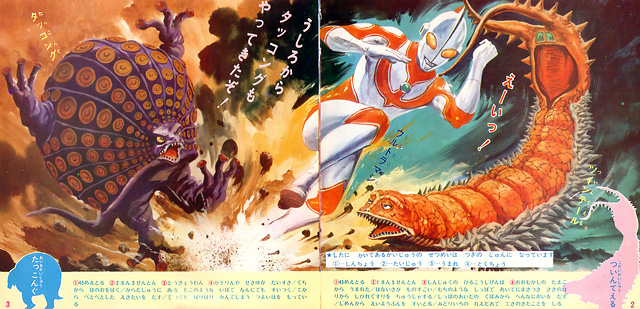
After a three year hiatus, the Ultra series would soon return in its fourth iteration, fittingly known as Return of Ultraman. While Eiji Tsuburaya unfortunately did not live to see the series’s resurrection, Return of Ultraman would become a hit for the 1970’s, and feature a wide range of unique and memorable kaiju like its predecessors.
TAKKONG
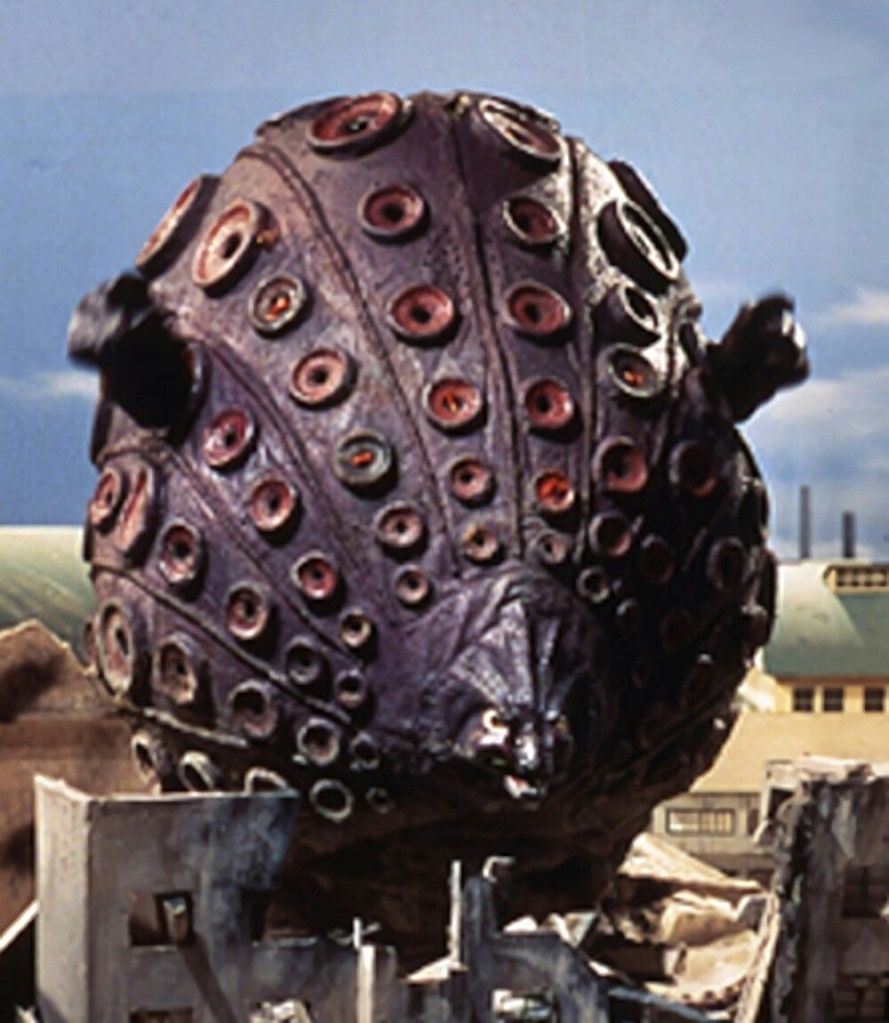
Our very first monster is actually one of my all time favorites: Takkong! Takkong here is one of three kaiju that show up in the premiere episode of Return, and of the three, he’s definitely the coolest in my book. While he only briefly shows up in episode 1 to battle fellow monster Zazarn, he leaves an impact on the show for sure, being the monster that kills our protagonist Hideki Goh. Goh’s heroism during his death is what causes the new Ultraman, Jack, to choose as his human host on Earth. Takkong would later show up as the main monster in episode 2.
Takkong has always been a monster I find to be very eye-catching, as well as one I’d personally consider as one of the best monsters from the show. Ikeya is back on monster design for a good chunk of the series, and Takkong is among his best creatures. While inspired by an octopus, Ikeya designed Takkong around the principle of hiding the suit actor, and I think he really succeeded on that. The spherical shape covered in suckers, with the head near the bottom of the body creates a really memorable monster.

Takkong sadly, wouldn’t appear again for decades after Return of Ultraman. However, 2019’s Ultraman Taiga would finally bring back Takkong, this time in a heroic role, teaming up with Taiga himself. It was a return long overdue, and it honestly brought a smile to my face to see the big lug high-fiving an Ultra hero. Here’s hoping Takkong will go on to clock in more appearances in the future.
ZAZARN
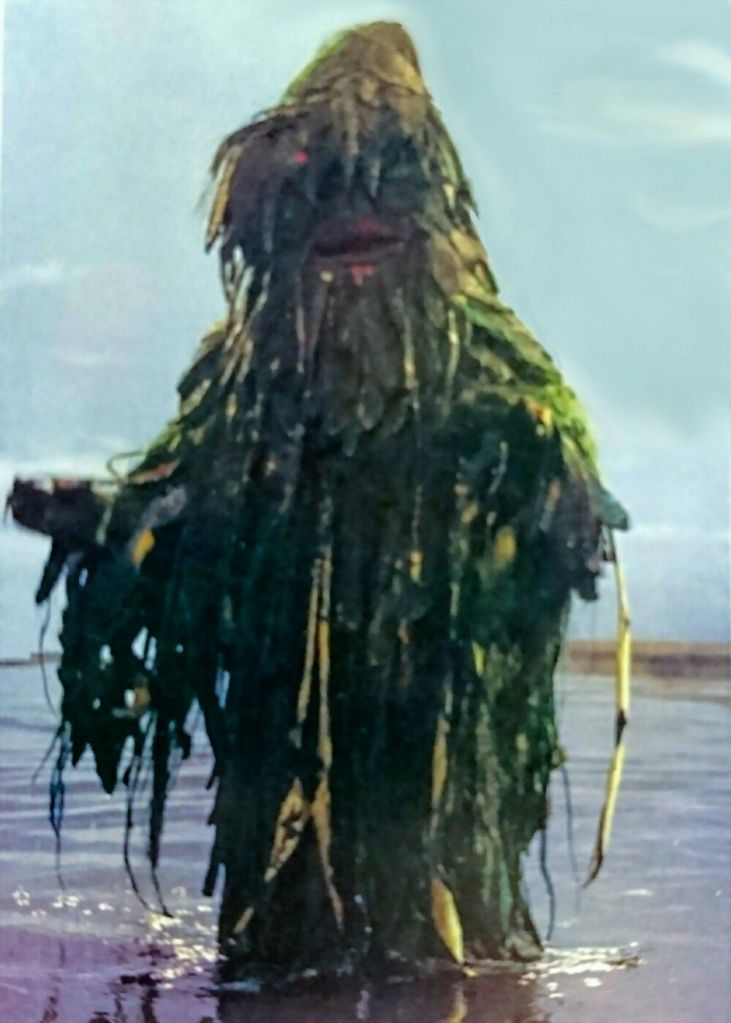
Takkong’s opponent, Zazarn, only lasts for a few minutes in episode 1’s opening before finally kicking the bucket. Despite being a throwaway monster, I can’t help but find Zazarn fun. A seaweed monster isn’t the most unique concept, but Ikeya was able to make Zazarn more memorable than he should be. I think it’s the visible mouth on the monster adds a lot of personality and charm than if it was just a blank face. Zazarn was originally supposed to have eyes as well, but I think I prefer the final version, as it just looks so wonderfully dumpy as a pollution-seaweed monster should be.
Zazarn’s origins behind the scenes are a bit more interesting than how he is portrayed in the show. In the late 60’s and early 70’s, Japan suffered from major pollution problems, and due to being such a hot button issue, many tokusatsu in 1971 such as Godzilla vs. Hedorah, and Spectreman would feature pollution as a theme. Zazarn was just one of many sludge monsters conceived during that time period, and originally was named Hedra in the design stages, not too dissimilar to Hedorah, and Hedoron from Spectreman, and was changed to avoid confusion among his fellow pollution monsters. Interestingly enough, there’s quite a few merchandise depicting Zazarn using similar smog based attacks as his fellow pollution monsters despite not using it in the show itself. Ikeya also gave Zazarn a seaweed motif in order to differentiate it from Keronia, the plant monster from the original Ultraman.
ARSTRON
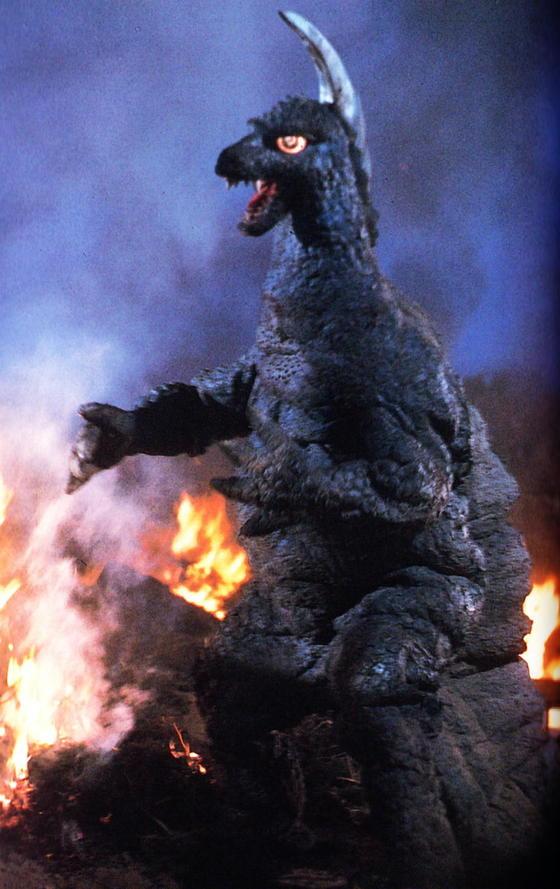
The third monster in the premiere episode of Return is Arstron, another fire-breathing reptile on the loose, who serves as the first opponent for Ultraman Jack in the episode’s climax.
Arstron nicely rounds out the trio of monsters seen in episode one, sometimes you just need a simple dinosaur kaiju after some oddballs. I think Ikeya did really well in designing a no frills monster that is just as memorable, and imposing as any of the classic kaiju like Red King, or Gomora. It’s been noted by many about Arstron’s striking similarities to Godzilla himself. While Arstron wasn’t made from a repurposed Godzilla suit like Gomess and Jirass, he is somewhat related to the King of the Monsters. Ishiro Honda, the director behind the original 1954 Godzilla and many of it’s sequels directed episode 1 of Return of Ultraman, and the suit’s sculptor, Noboyuki Anmaru, worked on several of the Godzilla films, including sculpting the 1984 Godzilla suit from The Return of Godzilla, an iteration of the character I feel looks quite like Arstron here.
Arstron would become one of the the most iconic monsters from Return, and make numerous appearances throughout the Heisei era series, even teaming up with fellow Godzilla look-alike Gomess in 2012’s Ultraman Saga.
SADORA
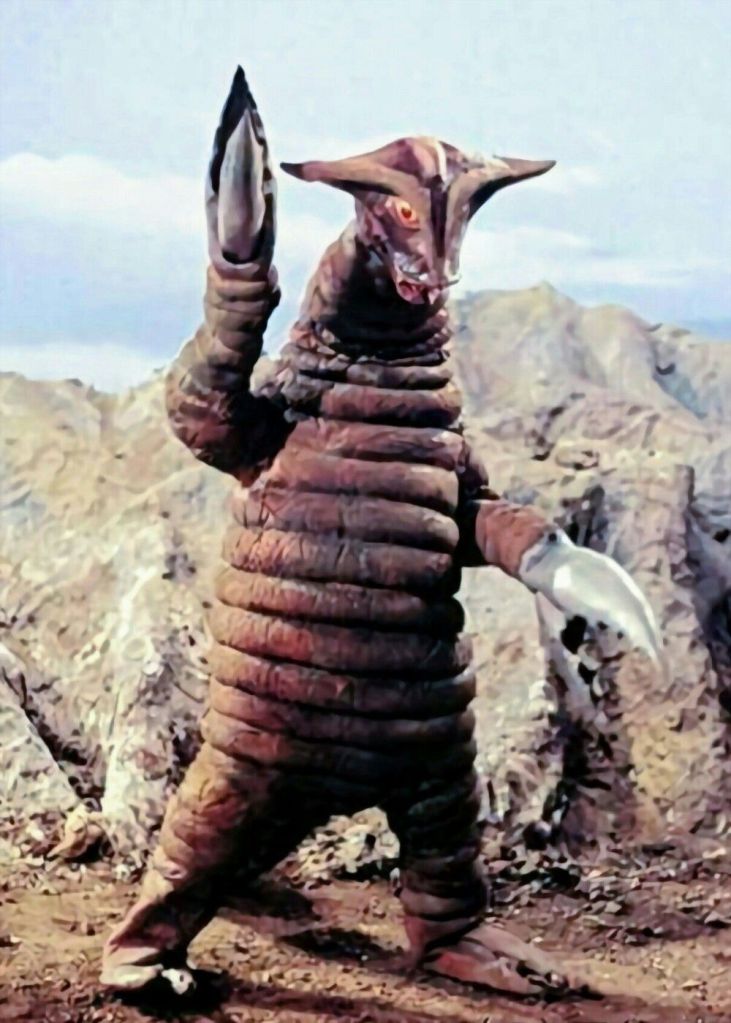
Hiding out on the top of fog-shrouded Misty Mountain, Sadora is one of two monsters responsible for the disappearances of multiple climbers. The captain of the Monster Attack Team, Kato, investigates the mountain alone after Goh senses a kaiju there. Kato soon finds himself in trouble when he comes across not only Sadora, but Detton as well. However, Kato is saved in the nick of time by Jack, who is able to slay both of the beasts.
Sadora’s pretty simple, and honestly not as nice looking as the three prior monsters, but I think it’s not too bad of a design. I feel like the hammerhead Sadora has adds a lot of charm to the monster, and the Baltan-like claws help edge him further into cool territory. Ikeya took inspiration from scorpions, and while a more traditional scorpion kaiju would’ve been fun enough, I think I’m glad they went with a dinosaur with Baltan hands in the end.
Sadora would surprisingly have a bit of a second life come the Heisei era. While not as prevalent as many classic monsters, Sadora would make numerous appearances in the late 2000’s, and gain the abilities to create a smoke screen (guessing Misty Mountain’s fog was his fault), as well as the inexplicable power to stretch its arms!
DETTON
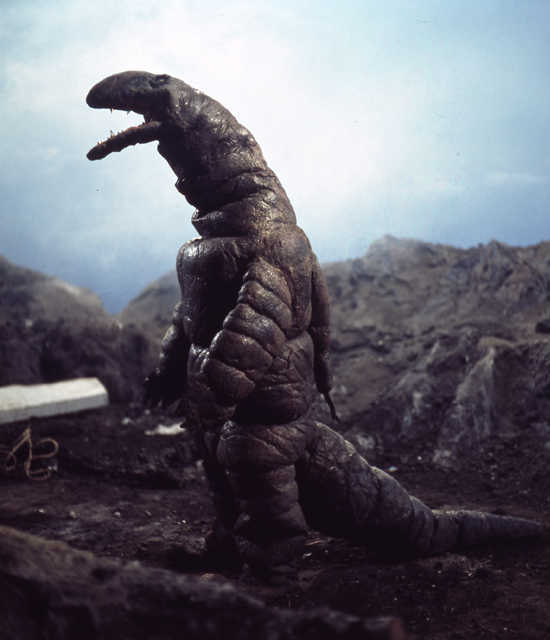
Sadora’s opponent, Detton, is another resident of Misty Mountain. Detton, like Sadora, menaces Capt. Kato. Detton soon finds his fight with Sadora interrupted by Jack, who destroys the monster with a Specium Ray.
Detton is probably the cheapest looking monster we’ve seen yet, and while I can’t deny that he looks really bad, there’s a certain, charm to him, maybe due to his resemblance to Jimmy Durante. Detton was born from the original Telesdon suit from Ultraman, and was originally supposed to be Telesdon itself. However, the costume had begun to deteriorate dramatically in the years between the two shows, and it was decided that this rotting Telesdon would be rechristened to Detton. I’ve always thought it was really fun when behind the scenes decisions impact the creative process. The resemblance to Telesdon is never brought up in the episode itself of course, but several magazines at the time would label the monster as Telesdon’s younger brother.
KINGSAURUS III
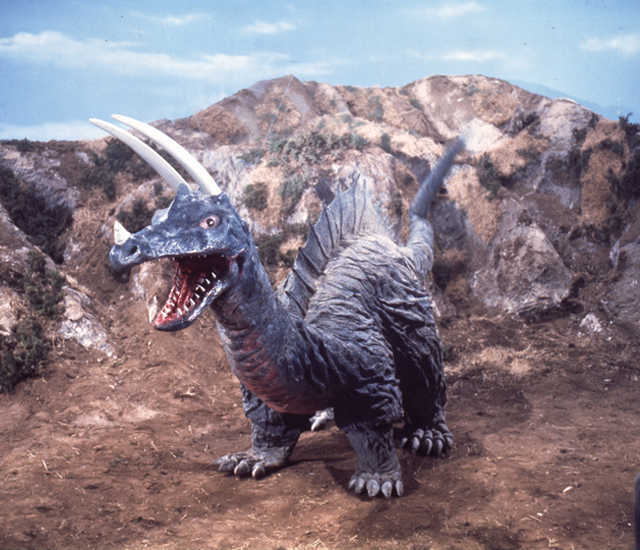
Unlike the previous two shows, Return actually has our hero lose his first battle relatively early on. Kingsaurus III, a radiation eating monster, proves to be quite the challenge for Ultraman Jack. The monster is able to create a powerful forcefield that blocks all of Jack’s attacks. Goh is then forced to train in his off-time in order to come up with a way to get past the shield and defeat the monster.
Let me just ask: why isn’t this guy a bigger deal? Of all the various monsters in this show that have become iconic, why isn’t this guy on the list? Kingsaurus no-selling Jack’s attacks in the opening minutes of the episode are a great way to show off how dangerous the monster is. In addition to just being tough as hell, the monster has a wonderfully fantastic design as well, being a really well-realized sauropod monster with some cool, curved horns, and a dimetrodon frill on the back to help him seem more monstrous. While many quadruped monsters previously seen were actors on their knees, Kingsaurus is brought to life in a way that it makes the monster seem incredibly convincing as an actual creature, rather than a guy in a suit.
Kingsaurus III’s original story was much different compared to the one we have on screen, with the monster being from Atlantis and then being revived in the modern day. As for the odd generational title in Kingsaurus’s name, that comes from the fact that it was a homage to two previous “king” monsters in the past shows: Red King, and Eleking. Sadly, unlike his two predecessors, Kingsaurus III has yet to appear again.
TWIN TAIL
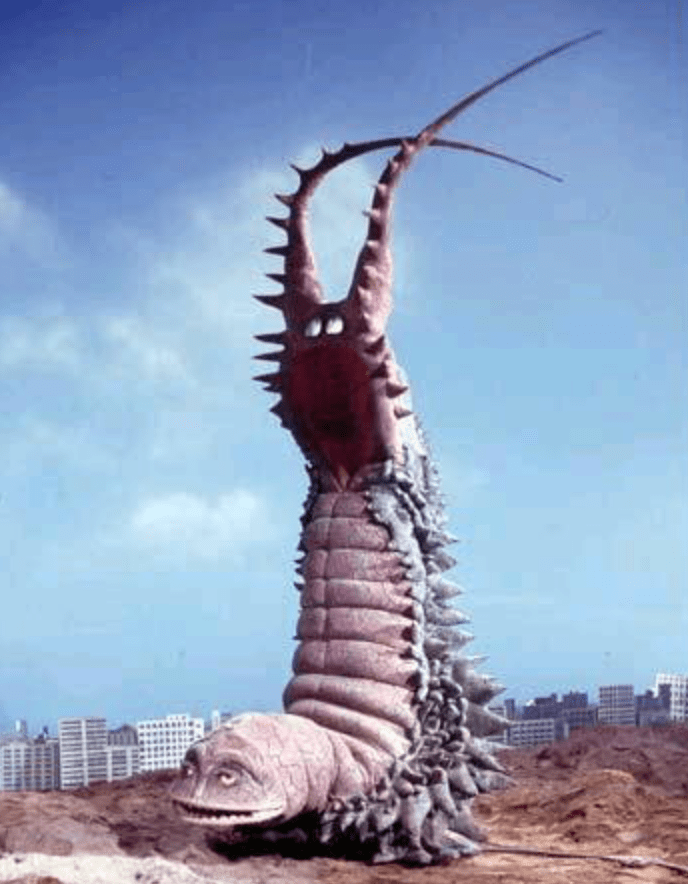
Hatched from a prehistoric egg found in a construction site, Twin Tail serves as a challenging foe for Jack. In addition, the monster’s hatching attracts its natural predator, Gudon, and the brawl the two monsters engage in threaten Tokyo.
If there’s any monster that is probably Ikeya’s masterwork, it is probably Twin Tail. Easily one of the most striking monsters seen in all of Ultra, it’s no wonder that Twin Tail would go onto become a true icon. The two-part story Twin Tail appears in is a classic through and through, and I feel like Twin Tail’s design itself helps edge the character into the status that it has. Twin Tail’s design is similar to Takkong’s in a sense; Ikeya wanted to design a monster that completely hid the suit actor inside of it, and I think he succeeded wonderfully. There’s a lot to love about the design of the monster-the whips are a unique weapon, the goofy face at the bottom of the body brings to mind that sort of ugly cute aesthetic creatures like Garamon have in spades, and I like the two glowing dots on top of the monster that give the impression of having a false head, something many real life animals have for a defensive mechanism.
Twin Tail would go on to feature fairly prominently, seeing as how it was easily among the most iconic monsters of the show. One notable appearance in Ultraman Mebius would confirm that the monster was amphibious, something only somewhat alluded to in the original episode with the ammonite-covered egg Twin Tail hatches from (which also nicely ties into the factoid that the monster tastes like shrimp according to some magazines).
GUDON
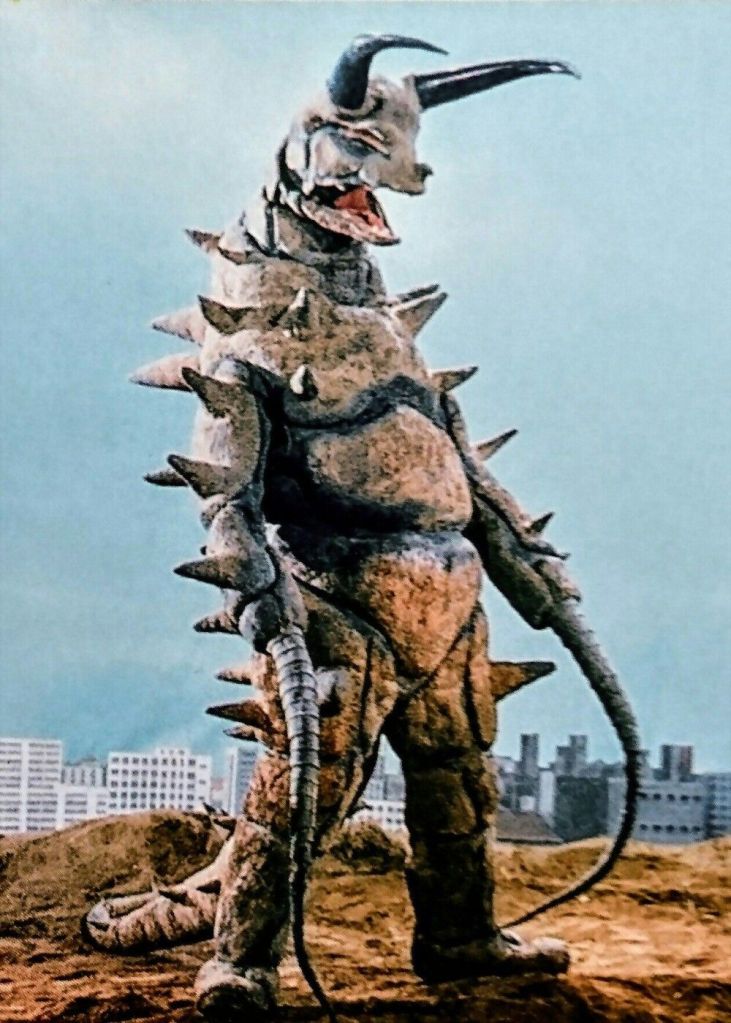
Twin Tail’s natural predator, Gudon, is naturally drawn to the birth of its prey and the two monsters serve as a challenge for Ultraman Jack and MAT.
While he’s not as much of an oddball as Twin Tail, Gudon’s another really well realized monster in my book. Ikeya applied the texture of a rhino to Gudon’s design, and it really helps sell how imposing he is. I’m a big fan of the horns he has two, which sort of give him a somewhat Satanic vibe, fitting considering he’s from underground. The whips are sort of an odd choice for a burrowing monster (how does he dig with those?), especially with how his natural prey has a similar set of weapons. Reportedly, Ikeya wasn’t aware that Gudon and Twin Tail were going to be in the same episode, and was not happy to see two monsters with whips in the same story.
Much like Twin Tail, Gudon would go on to make several more appearances in the series. However, among the oddest on the monster’s resume was his cameo in the 1973 Tsuburaya Productions show Fireman, as the victim of Nerogiras, a particularly vicious monster from the show. Interestingly enough, Gudon’s appearance in Fireman featured him underwater, which nicely ties into how Twin Tail is aquatic!
GORBAGOS
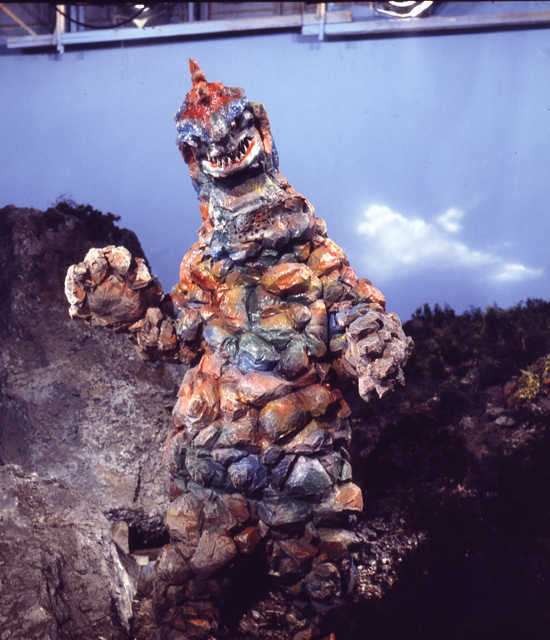
Gorbagos here, is a monster native to a mountain range. The creature led a reclusive life, until Jiro, the little brother of Goh’s girlfriend, Aki, snaps a photograph of the monster on accident. After the reveal of the creature, MAT plans to draw it out using Operation Rainbow, a plan where they would drop paint on the monster, neutralizing its camouflage ability.
I gotta say, of all the creatures we’ve seen so far in Return, Gorbagos is one of those few monsters that I think should have been spared. Throughout the episode, Gorbagos doesn’t do anything truly malicious, and is just minding his own business in his mountain home. Even when the monster comes across a bunch of teenagers throwing a party in the wilderness, he doesn’t harm any of them. And yet, MAT determines the poor thing has to be killed. I know it’s their job and everything…but c’mon, let the poor guy just live in peace.
Design wise, Gorbagos is an alright looking “rock” monster. He’s fairly plain, but the results of Operation Rainbow gives him an interesting color palette.
GHOSTRON
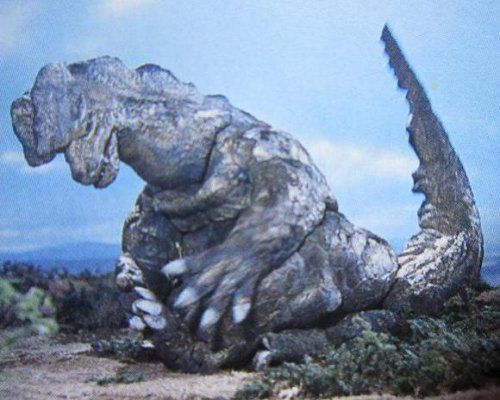
Appearing out in the wilderness, Ghostron soon becomes the target for MAT member Kishida’s powerful new X Bomb. However, Kishida’s new weapon has a timer to explode in 10 hours rather than immediately. Ghostron soon escapes, and a bad situation turns to a worse one when the monster remerges at a dynamite factory and takes a nap next to it, with the bomb’s counter ticking down..
Ghostron is another one of those monsters that I feel like could have been spared. Unlike several other previous monsters, Ghostron has a playful, impish nature to him, and isn’t interested in causing massive destruction. He’s more akin to a child, and I feel like the poor thing probably didn’t deserve such a death.
Design wise, Ghostron is pretty good. He’s a no frills dinosaur kaiju, but one of the better ones we see in the show. I like the sort of ridges going down his back, and his color scheme is nice and simple without being dull. The suit is a refurbished Arstron suit, and fittingly enough, some magazine publications would label the monster as the brother of Arstron.
DANGAR
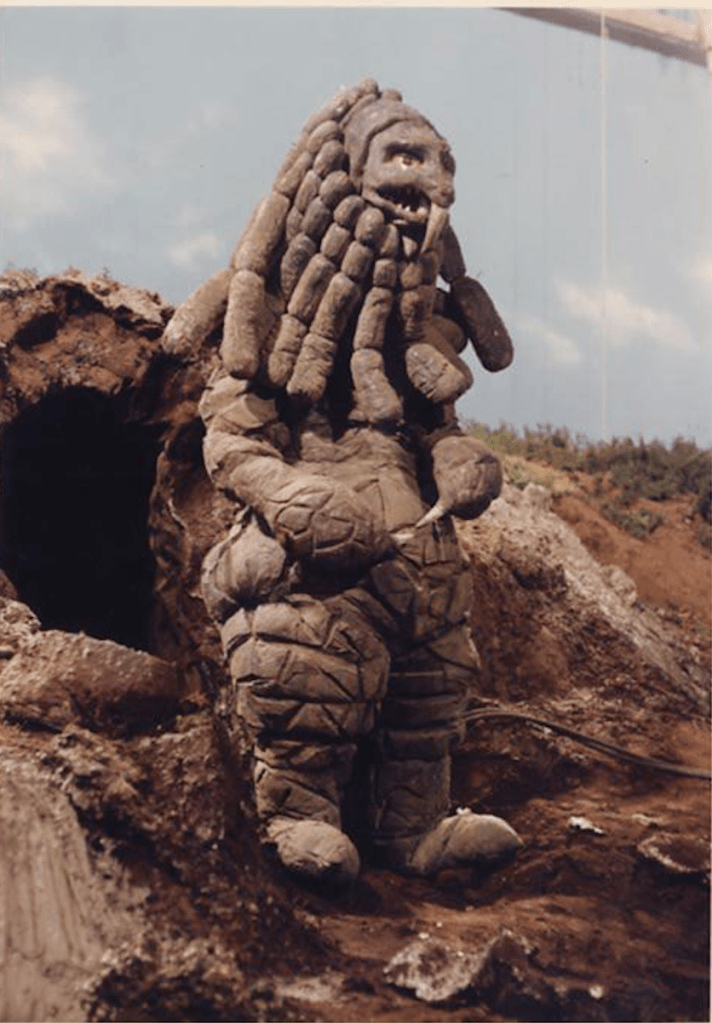
The sole inhabitant of a deserted island, Dangar menaces MAT member Minami, who finds himself stranded on the island.
There isn’t too much that’s complicated with Dangar, but I find him fun enough. The most noticeable thing about this guy are his “dreadlocks”, which supposedly give the monster his energy. Ikeya supposedly drew inspiration for that feature from lions, albeit the final result doesn’t really look like a mane. Dreadlocks aside, there’s some other fun features on Dangar, such as the spikes in place of hands, and the long, middle tooth which helps the monster be reminiscent to the same kind of belligerence that Red King is.
STEGON
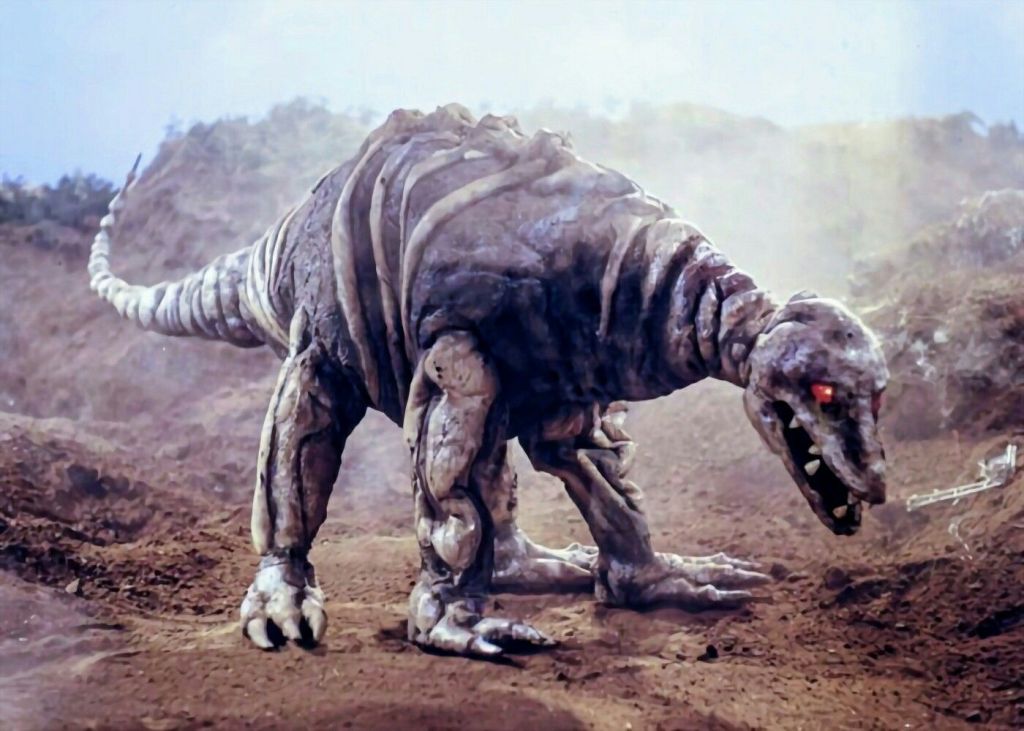
Originally discovered by Jiro’s elementary school class, a construction team accidentally awakens this ancient monster. Stegon is mostly harmless, but the acidic saliva the creature wields forces MAT, and Ultraman Jack, to step in. However, during the battle with the monster, Jiro and his classmates beg Jack not to kill the monster, and the Ultra then takes Stegon out into space, where it can live peacefully.
Stegon’s always been a monster I’ve found really cool. Like Kingsaurus, he’s a nicely realistic looking dinosaur monster. The skeletal motif here is really cool as well, bringing to mind Seabozu, but not being an exact carbon copy of him. I really like his skull, as it makes him simultaneously look both pathetic and creepy.
While I’m happy that Stegon didn’t just find himself killed by the hands of MAT and Jack like Ghostron and Gorbagos, I do think it’s sort of ironic that the monster first monster to be spared in the show is also one that kills some people in a pretty awful way.
MOGNEZUN
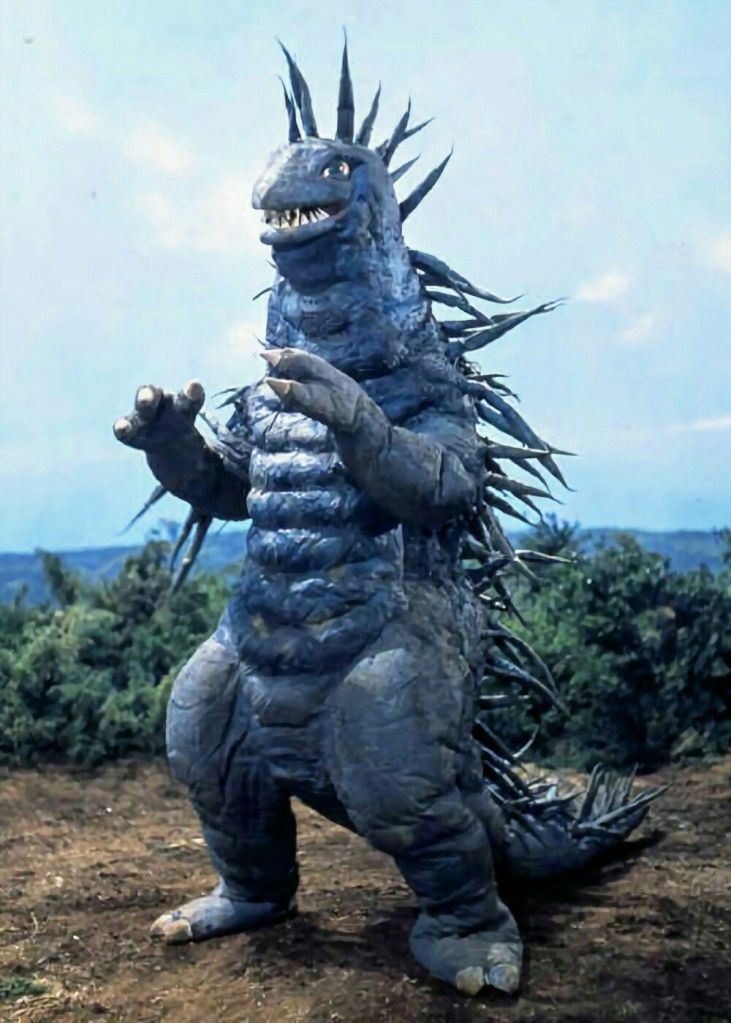
Mognezun here is a monster with the ability to spew an incredibly lethal yellow gas from its maw. During MAT’s investigation however, it’s discovered that the monster gained this lethal ability from consuming a chemical weapon developed by the Japanese Army during WWII. This weapon, known as Yellow Bullet, was developed by MAT member Kishida’s father, driving Kishida himself to go after the beast.
Design wise, Mognezun is alright, the suit itself isn’t as nice looking as a lot of the monsters we’ve seen thus far in the show, but I do like the hedgehog inspired spines on it’s back, even if they’re not entirely convincing. What really makes Mognezun interesting the story itself. Mognezun representing the war crimes that Japan committed during the Second World War, and how it ties to Kishida’s (representing modern Japan) own lineage is truly gripping. In addition, the story itself draws from an incident early in 1971, where the United States military moved chemical weaponry from Okinawa to the Johnston Islands. Known as Operation Red Hat, this planned disposal came from an earlier incident in 1969 when a leak of the weapons poisoned 20 US soldiers, and prompted a major public outcry from the Okinawans and Americans alike. Mognezun’s episode would be the last one written by the incredibly influential Tetsuo Kinjo, and it’s not a bad sendoff for one of the main architects of Ultraman.
 Easter's Kaiju Kompendium