SHUGARON
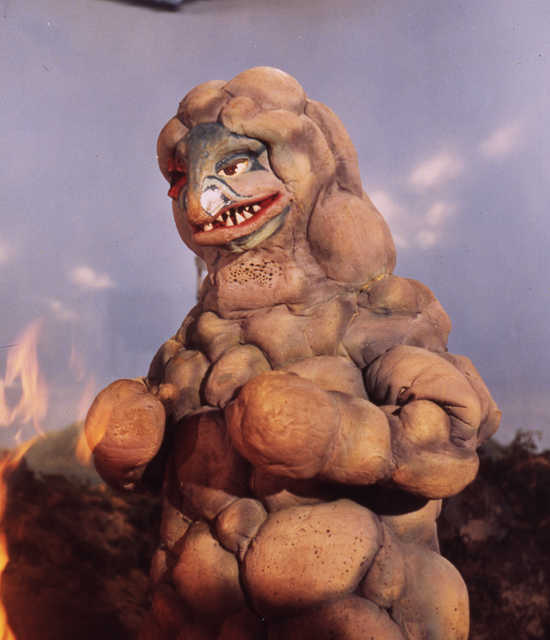
While Shugaron may seem like one of the more plain looking monsters in the show, his backstory is where things get weird. Apparently the traffic-hating monster is the reincarnation of a young girl’s artist father who had died some time ago. Normally a peaceful beast, Shugaron becomes enraged by construction of roads into its territory.
Shugaron is a monster that I feel like is close to being a really iconic monster, but doesn’t quite hit the mark. The story of a human being reincarnated as a monster was used several times in the original Ultraman, and the episode feels like it wants to be a take on the Woo story, but aside from the light environmentalism angle, it lacks the social commentary and tragedy present in the Woo episode.
Shugaron’s design is simple, but effective. The monster at first looks like he’d be going for a rock-based motif ala Gorbagos, but apparently Ikeya drew upon marshmallows for his design, fitting considering his name. I think the design is pretty fun, with Shugaron’s face and puffy body making him look kinda cute in an odd way. One thing to note is that Shugaron will be the last Ikeya designed monster we’ll be seeing for a bit. While we’ll definitely see at least one more Ikeya monster down the road, several different designers will be taking over for the remainder of the show.
SEAGORATH AND SEAMONS

A pair of sea-dwelling monsters (if their names didn’t give it away), Seamons initially surfaces on Japan in order to lay her eggs. However, MAT’s attack on the monster angers her mate, Seagorath, who summons a massive tsunami. Even after Jack stops the tsunami, the monsters prove to be a powerful pair of enemies to Ultraman Jack and MAT, and it becomes a race against the clock to discover a way to drive these monsters away.
Of the monsters in Return, I think these two are some of the best. These two guys were designed by Ken Kumagi, a producer for many of the Showa era Ultraman shows, and the one who would go on to design a good number of monsters seen in Return. Kumagi’s monster design principles would vary in terms of Ikeya, and they are as follows:
- Designs based on real animals
- The designs should give the impression that the monster is strong
- Children watching should be able to imitate the monster easily
- The monster should have a dramatic weapon.
It’s a shame Kumagi’s monsters aren’t as appreciated in the same way as Narita’s and Ikeya’s monsters are, because I feel like Kumagi came up with some great monsters, including some of my absolute favorites, and this pair of monsters are a great start to his tenure of designing kaiju. Based on roosters and hens, I feel the two monsters are great design wise. Seagorath commands the most attention, with the large nasal horn, and bipedal stance. Originally, he was to be quadrupedal like Seamons in the initial design drawings, and while I’m not sure exactly why he was changed to bipedal, but I think it adds some nice contrast to the two, and kaiju sexual dimorphism is something that isn’t really seen. Seamons herself is a nice design too, and I think it’s interesting that they decided to make her fairly plain looking, much like how it occurs in nature. I also would like to mention their weather manipulation powers, which somehow really fits a couple of deep sea monsters, and makes them a unique threat.
Despite surviving their final battle with Ultraman Jack, Segorath and Seamons would not make an appearance after their two-part story in Return. Seagorath would briefly return via stock footage in episode 37 of Return as a minion of the Nackle aliens, and would be considered to show up again in Ultraman Ace before being replaced by fellow Return monster Muruchi. Seagorath would find some immortality as the creature’s head would be a component of the chimera monster Tyrant from Ultraman Taro. However, despite never showing their faces again, a 1973 children’s magazine article would state that the two monsters retired to the ocean floor to raise a whole litter of Minigoras which is just too adorable.
ELEDORTUS

Coming after Kumagi’s excellent Seagorath and Seamons, Eledortus is a bit of a let down. The monster’s main schtick is that it consumes electricity, and can become invisible, making Eledortus just a retread of Neronga from Ultraman in almost every way. The only thing thing in the story that makes Eledortus stand out is the fact that the monster killed a boy’s father by derailing a train, and the episode dealing with the boy trying to convince people that his father was killed by the monster.
The design itself is alright. While it’s never been officially stated, the design brings to mind softshell turtles. The original design drawings also gave Eledortus some hair around the neck, but this was dropped when the suit was made. Eldortus’s original name during planning was “Mieron”.
TEROCHILUS
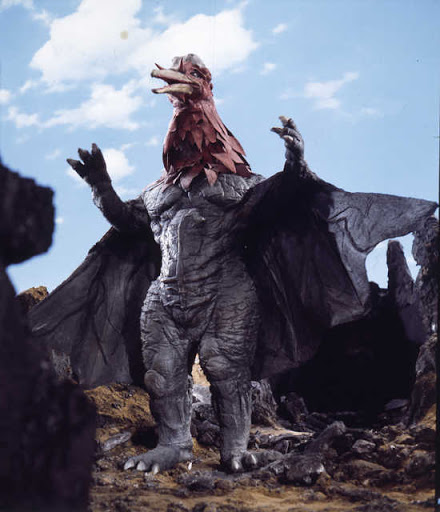
A gigantic, prehistoric bird, Terochilus awakens in the modern era after a volcanic eruption on the ominously named Evil Island. Making its way to Tokyo (of course), the monster begins to create a nest in the city, being attracted to the smog-filled city as it reminds Terochilus of its former volcanic home.
Terochilus like Eledtortus before him, feels quite too plain for my liking. The design itself is a decently admirable take on a bird monster, and looks a lot nicer than say, Hydra, but there’s really not much to the creature itself, especially considering the fact Terochilus has his own two-parter story. I do like the webbing ability the creature has, since that’s a fun sort of way to justify what kind of material a kaiju-sized bird would use to make its nest.

The original design of Terochilus by Kumagi had a strange protrusion on the top of his head that I feel would’ve made the final suit much more interesting to look at. The design was based off of pteranodons and that motif helped inspire the monster’s name.
BEMSTAR

Arguably the most iconic monster from Return, Bemstar ushers in an entirely new era for the show, as well as being instrumental to changes that would occur in the Ultra series as a whole. Bemstar here is actually the first space-based monster in the show, and to make a point of his origins, consumes a MAT space station before heading to Earth. Ultraman Jack seemingly has no way to combat the creature, as the pentagonal mouth on Bemstar’s stomach absorbs Jack’s Specium Ray. Low on energy, Jack flies out to the sun to regain energy, and soon returns with the powerful Ultra Bracelet, given to him by an old friend, that gives Jack the edge to vanquish Bemstar…
Bemstar off the bat marks some major changes for not only Return, but also all of Ultra in general. Return‘s monsters until now reflected the more grounded nature of the program, and with Bemstar’s arrival, we’ll be seeing some more alien monsters, as well as some just weirder creatures in general. This change was born from surveys Tsuburaya Productions sent out during the airing of Return, and a common request among fans at the time were the inclusion of space monsters into the program. In addition, Bemstar being a powerful enough foe that forced Jack to gain a new type of weapon would become a well-worn trope not only within the Ultra series, but tokusatsu in general.
In terms of design, Bemstar is one of Ken Kumagi’s best. You can see all of his monster designs principles at play here and they’re firing on all cylinders. Kumagi designed Bemstar around the idea of a bird being shaped like a pentagon, which makes for a great space monster design. I’ve always felt a great character design is one where you can recognize them by silhouette, and going by that criteria, Bemstar is a winner. I can’t talk about Bemstar without talking about the creature’s true mouth that’s located in the center of its body. It really helps sell the fact that Bemstar is an alien, and the opening scenes of Bemstar using it to consume the MAT space station are nothing short of horrific.
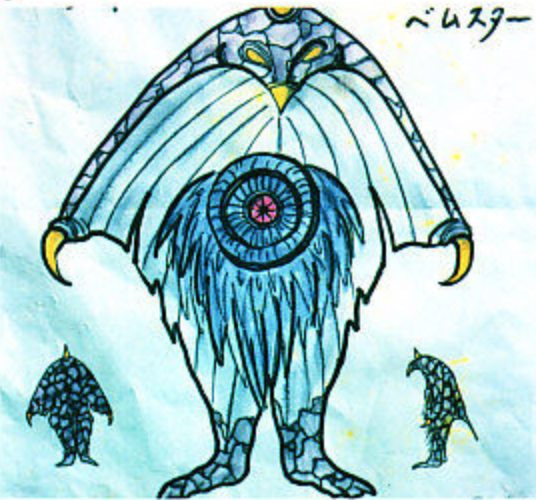
Bemstar would go on to become one of the most popular monsters of the entire franchise, and would go on to make many appearances past his debut. Of these, one of my favorites was his team-up with Zarab in 2015’s Ultraman X, where Bemstar actually ate the titular Ultraman!
SARTAN
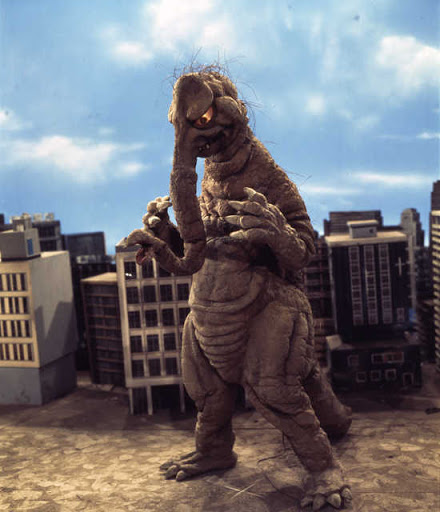
Arriving in a meteorite that’s discovered by little Jiro, Sartan, a monster composed of neutrons, emerges from the space rock. The creature becomes a problem with its ability to make itself intangible, and invisible.
Sartan is a monster that I feel is sadly underrated amongst the kaiju of this show. I’ve always found elephant derived monsters to be really underused motifs for kaiju, and Sartan’s one of the best examples of one. I also really like the odd proportions, crazy eyes, and strands of hair on top of his head, and all those design elements really make Sartan feel like a more demented Dr. Seuss character. In addition, the invisibility, and intangibility powers definitely make the monster stand out compared to monsters with similar powers like Gorbagos and Eledortus.
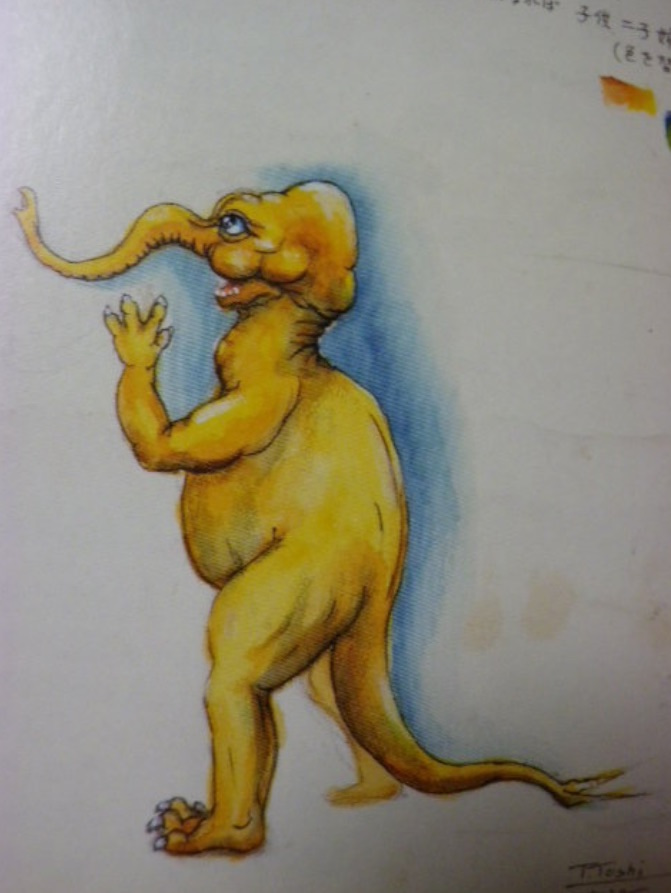
Unlike some of the more recent monsters, Sartan wasn’t a Kumagi creation, but rather, was designed by Teiko Toshimitsu, a monster sculptor who worked on many classic Toho kaiju films. The original design drawings by Toshimitsu featured a baby Sartan alongside the adult, which implies to me that the original story featured the adult Sartan attempting to reunite with its child.
MAGNEDON

Magnedon, if his name didn’t give it away already, is a magnetic monster. Emerging from deep beneath the Earth, the monster’s magnetism proves to be strong enough to crash airplanes. MAT is able to destroy the creature with a powerful bomb, but its magnetic abilities allow itself to reform, and Ultraman Jack soon teleports it deep into outer space where he can destroy it after its been cut off of Earth’s magnetic field.
Magnedon is another one of those monsters I feel like should have maybe been spared. While I can agree that crashing airplanes is a bad thing, that was only a side effect of Magnedon being in the area, and the monster when unprovoked, just wants to sleep. You’d think after being transported into outer space where Magnedon’s abilities are essentially cut off, that Jack would just let the poor thing be left alone, but no, Magnedon has to be blown up like the rest of the kaiju riffraff. That being said, apparently some magazines at the time suggested Magnedon survived and eventually put itself back together, but it’s made clear in the episode that Jack dealt a killing blow.
Design wise, Kumagi’s back, and he did a great job with Magnedon. It’s another fairly realistic quadrupedal design, being based on the Kentrosaurus. The red horns serve as a really nice contrast on the dark blue body, and also bring to mind horseshoe magnets, fitting considering his powers. Magnedon is just a nicely done monster in all aspects.
BEACON

A monster originating from Earth’s ionosphere, Beacon has the bizarre ability to absorb and broadcast radio signals, causing what the monster sees to play on local TVs.
Beacon is by far, one of the strangest monsters we’ve seen in Return, and easily one of the weirdest just in general for Ultra as a whole in my opinion. Going over the design, Beacon looks downright wacky with the multi-colored spikes on his back and most importantly, the three-eyed face that makes him look like a traffic light monster (despite not having any abilities of that nature). The fact that Beacon is some sort of life form native to Earth’s atmosphere, rather than some space monster, makes me really wonder about how strange the turns evolution must have taken in the world of the Showa Ultra series. He reflects a certain zaniness that was very prevalent in Ultra back in the 1970’s, and for that, I love Beacon. He’s such an odd duck, but without the odd ducks in the pantheon of kaiju, Ultraman just would not be Ultraman.
GOKINEZULA
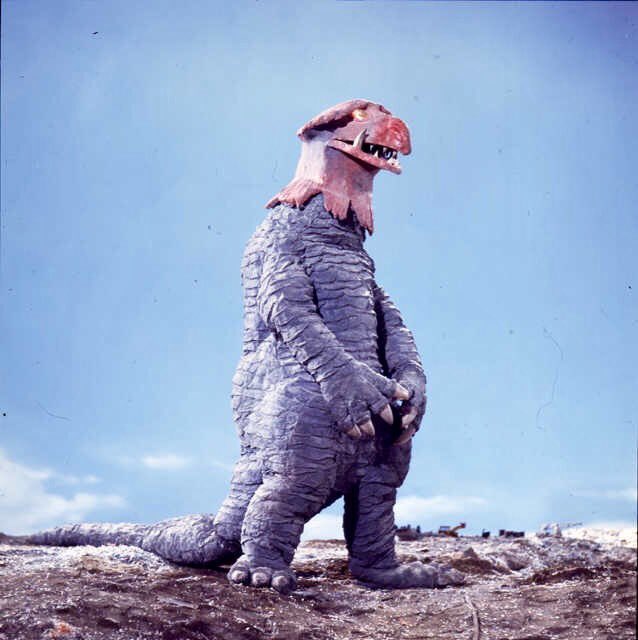
A strange, plastic-eating monster found on the artificial waste island known Yumenoshima (or the Island of Dreams), Gokinezula becomes the first opponent MAT faces with their new leader, Captain Ibuki.
Gokinezula has always been a monster that I’ve enjoyed thanks to just how strange he looks. The cartoonish face, complete with a Moe Howard haircut on top of the blue body oddly fits the plastic/garbage theme that is associated with the monster. I’m also a big fan of the monster’s webbing ability, which is actually just plastic after the monster had consumed it. Interestingly, Cap. Ibuki mentions battling a different Gokinezula in New York City in an off-hand comment, implying there’s more of these guys running around in the garbage dumps of the world.
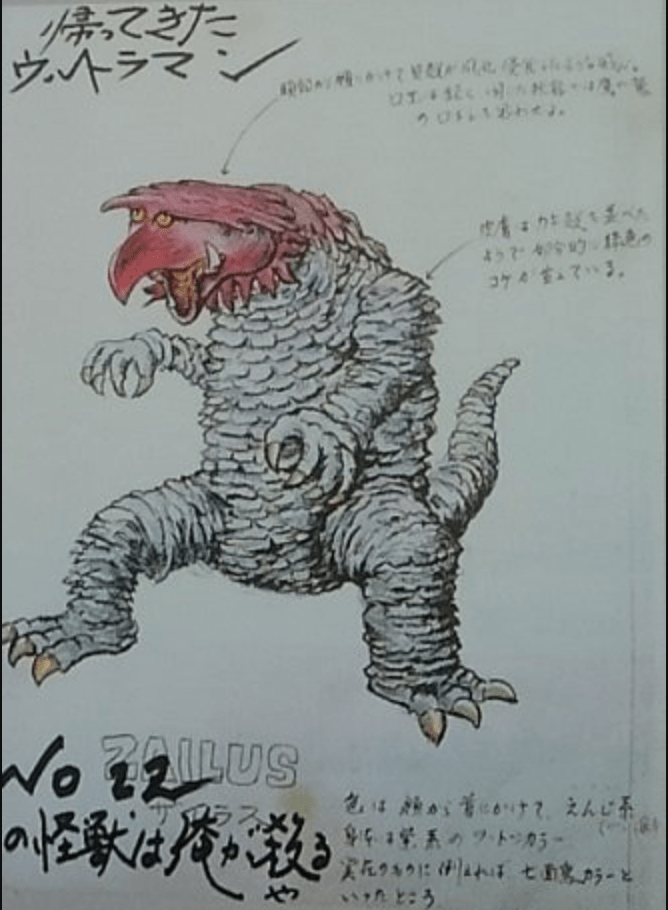
Gokinezula was designed by Masashiro Sueyasa, who was in charge of sales for Tsuburaya Productions at the time. The monster’s name derives from the Japanese words for cockroach (goki), and rat (nezumi), fitting for a monster that calls a garbage dump his home. Interestingly though, Sueyasa’s drawing of the monster were meant to evoke various aspects of birds (eggshells for the textures, eagles and hawks for the beak, turkeys for the color scheme) and was going to originally be named Zailus at this stage, which makes me wonder what the original story attached to the monster was going to be before the final episode.
ZANIKA AND VACUUMON

Okay, buckle up, because this is going to get weird really fast.
Zanika here is native to the Cancer Constellation, but soon finds herself on the run after the stars in it are swallowed up by the monster Vacuumon. On Earth, she possesses a a female astrologer named Junko, whose odd behavior attracts the attention of MAT. While there’s some initial conflict between Zanika and Ultraman Jack, the hero from M78 soon realizes that the true enemy is Vacuumon, and he flies off into space to defeat the star-swallowing monster.
Zanika is an alright monster. The idea of the spirit of a constellation on the run is a fun concept, and it’s the sort of thing that doesn’t feel out of place in a series with money-eating monsters, and vampire plant people. It actually sort of reminds me of the more whimsical characters found in shows like Ultra Q, as well as the ones in the 1970’s entries following Return. The design itself isn’t too striking, especially for a space monster, but I do think it works in its simplicity. Kumagi reportedly based Zanika off of fried crab, which accounts for the brown coloration. I’m also glad that Zanika is spared by Ultraman Jack, unlike a fair number of monsters we’ve seen thus far in the show.
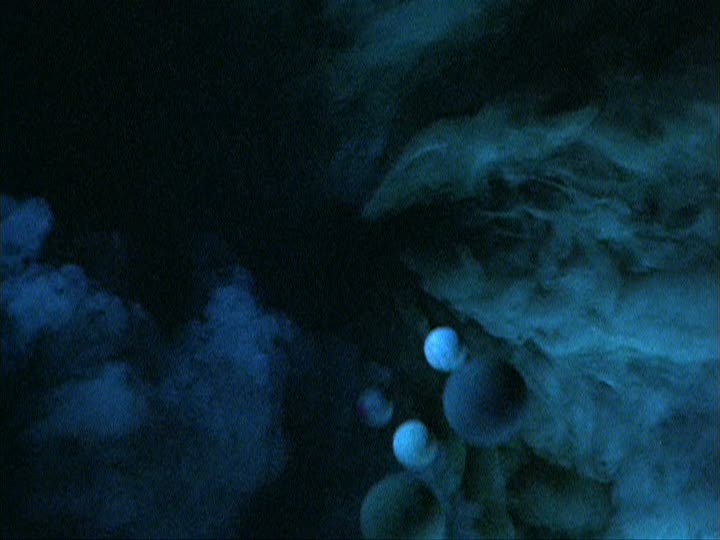
Vacuumon, the true antagonist of the episode, is truly something worthy of the title of cosmic horror. A monster that is even more gargantuan than the planets and stars it consumes, Vacuumon is a monster that easily could serve as the show’s final opponent. There’s this sense of awful impending doom throughout the episode, and when it’s discovered that Vacuumon is headed straight towards Earth, that feeling becomes nearly overwhelming. There’s a great scene of an astronomer who discovers the gigantic monster headed towards Earth after having swallowed up numerous planets and stars in its path just breaking down as he realizes that there’s no escape. It really reminds me a lot of the Balloonga episode in Ultra Q, except blown up on a much larger scale.
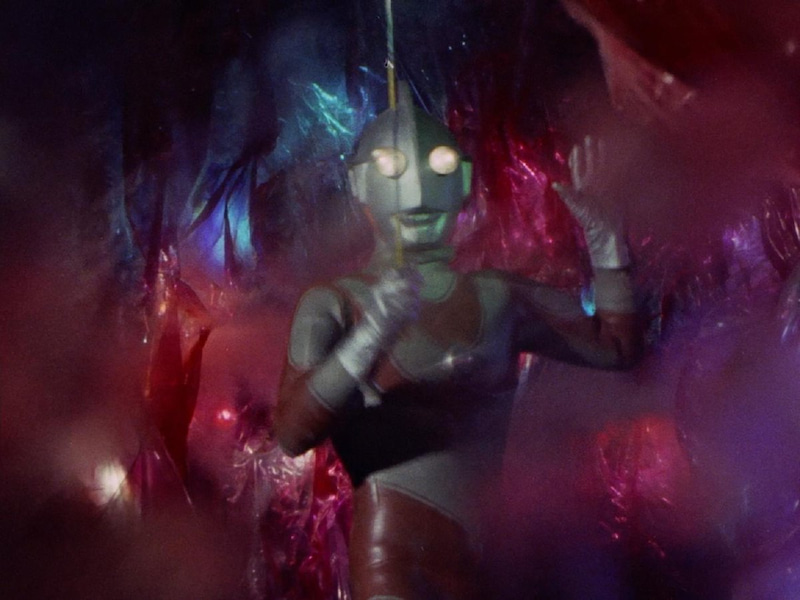
While Vacuumon looks like a cloud, the interior of the monster reveals a body akin to glowing, translucent sacs. The narration in this scene states that Vacuumon’s insides exert a tremendous pressure, and that even Ultraman Jack almost finds himself killed by it after he travels inside. Thankfully, Jack’s Ultra Bracelet kills the monster, freeing all the planets and stars that the monster had consumed.
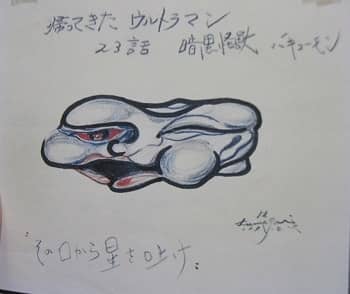
While Vacuumon seen in the completed episode looks like a massive black cloud with a glowing red dot inside of it, the original concept by Ken Kumagi basically made the monster a gigantic, grotesque head. While it’s a fun concept, I’m not exactly sure how it would’ve been pulled off convincingly with the special effects of the time. Additionally, the fact that Vacuumon is basically a giant cloud helps sell just how alien, and terrifying the monster is, like an awful storm that you can see approaching on the horizon.
KINGSTRON
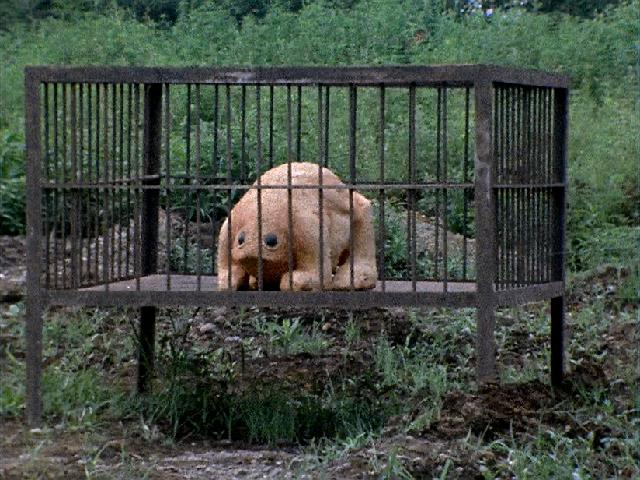
Kingstron actually starts off life as the tiny space monster Kupukupu. Little Kupukupu is captured by MAT, and is cruelly exterminated. While I can maybe understand the justification in killing a monster like Magnedon, Kupukupu isn’t barely bigger than a cat! There’s not much the poor thing can do, and yet MAT exterminates it only because it’s from outer space! Cruel bastards.
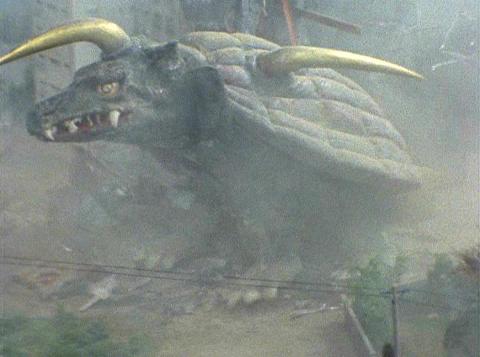
However, a young boy finds one of the remnants of Kupukupu, and takes it back to his apartment. The piece he found soon absorbs itself into the wall. Spurred by the little boy’s suggestions of how to look more fierce, Kingstron slowly mutates and emerges from the apartment complex.
Sort of an update on the Gavadon concept, Kingstron is a fairly fun little monster. The final design is alright. While there’s a lot of stuff I like about it (the shelled body, the menacing face with the large horns, the realistic quadrupedal stance), there’s something about the body that feels like it’s just missing something, and perhaps a tail or less floppy shell would’ve really helped the monster feel more complete. Unlike Gavadon, Kingstron isn’t spared in the end, but of all the monsters we’ve seen, his rampage feels a tad more justified. After all, if you were blown up you’d probably be pretty pissed.
ZAGORAS

Born from microorganisms from Planet Zagoras, the larger Zagoras begins building a meteorite craft from materials it gathers in order to return to his home world.
Zagoras is another one of those monsters that I feel was unfairly killed by Jack. Sure, what he was doing was destructive, but the monster wasn’t doing this out of any maliciousness, and just wanted to go home as his end goal. What’s really frustrating is that at the end of the episode, Zagoras gets his meteorite ride up in the air, ready to head off world, but Jack slams him into it, destroying both Zagoras and his craft in the process. That’s just cold man.
Design wise, I find Zagoras one of the weaker kaiju seen in the show. Kumagi based the monster off of giant salamanders. Giant salamanders are some of my favorite animals, but Zagoras doesn’t really come across quite well as a good example of the concept sadly, and feels more like a cheap squeaky toy than an amphibian from space.
NOKOGIRIN
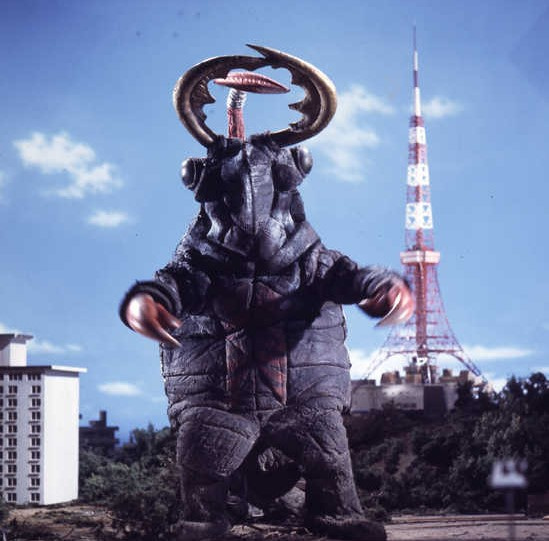
Originally only 7 inches long, Nokogirin arrives on Earth and quickly begins causing trouble with his deadly rays. The monster mistakes the buzzing of electric razors, and hair dryers as opponents, leading to several deaths. MAT eventually captures the space bug, and attempt to execute it via firing squad. However, the laser pistols actually mutate the monster, and it slowly grows giant..
Nokogirin is a really fun monster. I’m always fond of beetle based monsters, and Nokogirin here is a clear winner with his red claws, stag-beetle jaws, and death-ray shooting horn. I find the idea that Nokogirin started off as a smaller insect monster, before being mutated by MAT’s own weaponry to be a really novel way to get the monster to grow giant for the final battle.
 Easter's Kaiju Kompendium