GORGOS
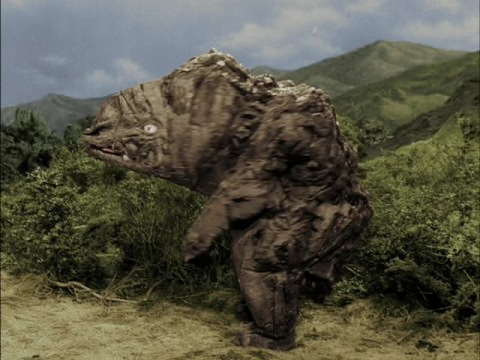
Gorgos has always been one of those monsters I’ve felt torn on whether or not I find the creature too plain or just right in terms of simplicity, but I tend to fall probably towards the latter. Gorgos is a pretty decent representation in terms of the concept of a rock monster. Gorgos’ head looks like a mountain range mixed with some sort of lizard and it’s a lot more interesting than if Narita designed a rock monster more literally. Gorgos was originally supposed to have a whip-like tail illustrated in the original concept drawings, but it was scrapped. I suppose it’s for the better since I feel like such a feature would detract from the rock monster concept they were aiming for.
The oddest thing about Gorgos in my book though, is the fact that he possesses Godzilla’s roar for his vocalizations. Not just some kind of remixed roar, the actual Godzilla roar which is just so bizarre coming out a monster that isn’t Godzilla.
MONGULAR
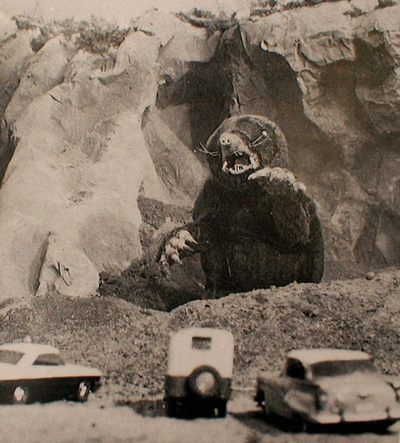
Mongular’s another one of those early giant animal Q monsters, this time being a mole exposed to an experimental growth formula brought up to kaiju size before it’s untimely demise at the end of the episode.
While you’d expect me to label Mongular as one of the more boring creatures in Ultra Q, I can’t help but have some fondness for him. He’s incredibly plain for sure, but I actually find the suit constructed for him to be fairly well done. The tiny, white eyes contrasted with his black-furred body makes the monster look genuinely eerie in Ultra Q’s black and white photography, elevating what would be another fairly boring monster into something visually interesting at least.
TARANTULA
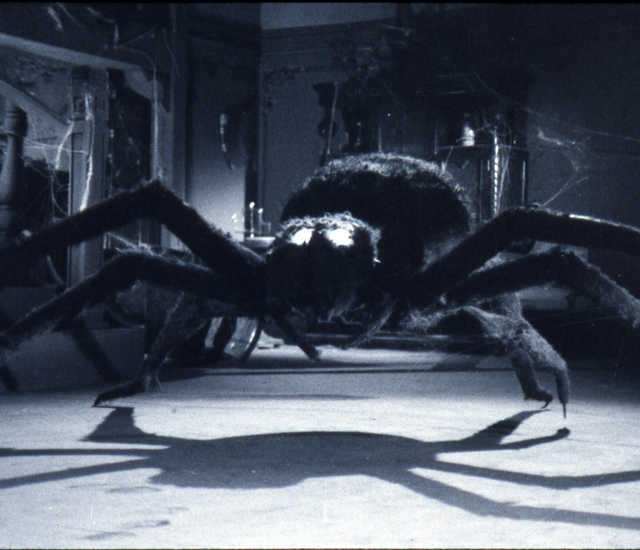
Much like the previous few giant animal kaiju, you’d assume the two giant Tarantula monsters from Ultra Q’s ninth episode would be created by mad science gone awry, but the story here is one that is incredibly more macabre…
The two spiders haunting the abandoned mansion that’s our story’s setting are implied to be the former spider-loving baron and daughter transformed into the two monsters. It’s quite honestly one of the more disturbing origin stories for an Ultra kaiju and it easily feels like something out of a pulp magazine or horror film rather than a Japanese science fiction show.
Adding to the horror in my book is just the size alone of the spiders themselves. Rather than the building destroying monsters we’ve seen prior, the Tarantulas themselves are 2.5 meters long, allowing them to easily stalk prey and hide in the shadows of the ruined mansion they call home. While admittedly the operation of the puppets isn’t as impressive as Kumonga from Son of Godzilla a year later, the effects team does an excellent job bringing these monsters to life and while I wouldn’t say I’m an arachnophobe, I can’t deny just how undisputedly creepy these two are and I imagine they brought more than a few nightmares to viewers back in 1966.
M1
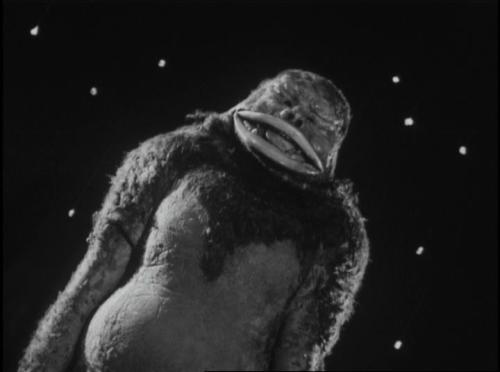
M1 is one of those monsters that immediately caught my eye when I was getting more into the Ultra Series and to be quite honest, I still view him that way even after seeing nearly every kaiju the series has to offer.
I think M1 is the sum of a lot of really cool ideas and designs rolled into one monster, something that a great number of creatures don’t get. I’m a big fan of his origin story-being a vial of artificial cells brought onto a super express train that after being exposed to the flash of a camera, grow into M1. While the monster isn’t malicious in and of itself, the creature causes all sorts of accidental mayhem before being flung into outer space by the end of the story.
I think M1’s design is really hits that classic “Ultra Q” vibe to it. While he’s reminiscent of various primates, he’s not an exact 1:1 of them and I think Tohl Narita did an amazing job creating a creature that really captures that vibe. The suit constructed for the monster is truly wonderful and the sculpting and proportions on the face and body in my opinion, give me all sorts of different emotions associated with the design. M1 simultaneously looks comedic, pitiable and quite honestly, genuinely eerie.
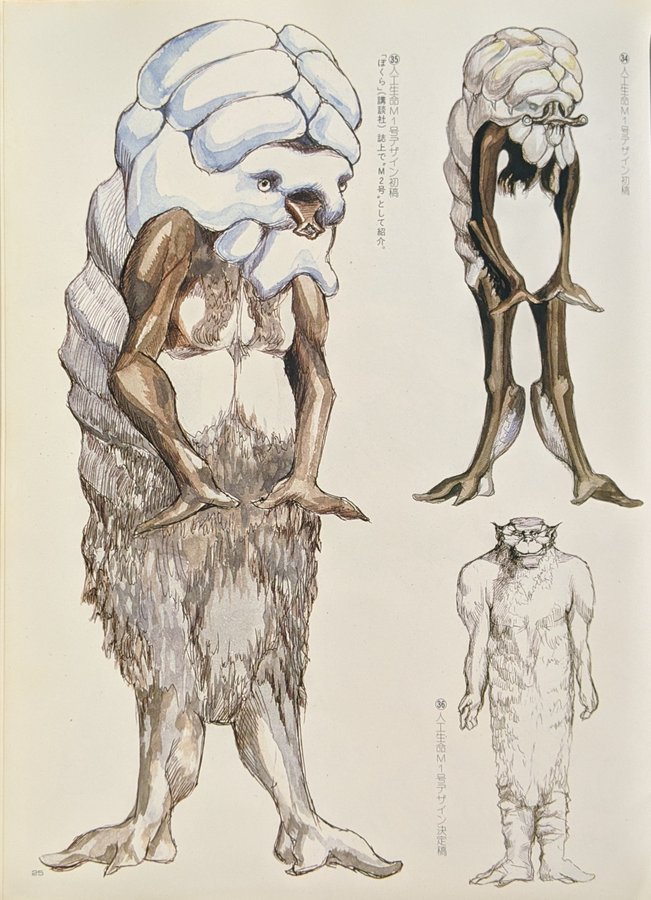
M1 was originally going to be a more insectoid creature reminiscent of the aliens created by artist Ed Cartier, and while I do enjoy the original piece of concept art, I can’t imagine it being as good as the M1 we got. This version of M1 would be published in some magazines as M2 and would even get a few model kits based off of him. The second design by Narita is pretty close to the final version, albeit with pointy ears.
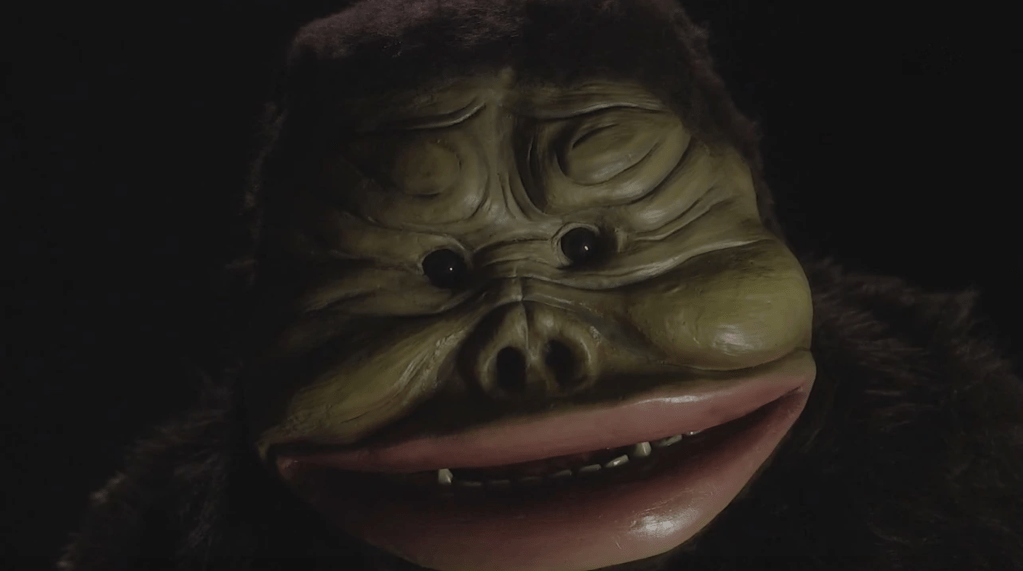
While M1 isn’t one of the most popular of the Q monsters, the creature did have some life beyond his individual episode, appearing as one of the monsters in the Birth of Ultraman TV special made to drum up some excitement for Ultraman. As of the 2010’s, M1 made some appearances on Ultra Zone, a variety show filled with all sorts of classic Ultra Kaiju. His most significant role in my opinion however, is his reappearance in 2015’s Ultraman X. I suspect the crew of the show felt similarly to me in terms of M1’s strange nature as here, the artificial monster is now living in Earth’s orbit and has become basically omnipotent, trapping Ultraman X away from Earth in order to determine whether or not humanity and monsters can truly coexist. I’d like to make mention that while the original M1 costume allowed the actor’s eyes to be seen, the one in X has completely black eyes. According to production staff, this was done to sell the idea that M1 has truly become the ultimate life form. It’s sort of odd to see a fairly minor and overall comedic monster becoming a near-godlike judge of mankind, but it’s something that fits a weirdo like M1.
BALLOONGA

While all of the previous kaiju have been dangerous in their own ways, Balloonga represents something new to the show: A threat to the entire planet.
Born from a space spore stowing away on an exploratory craft, when Balloonga arrives on Earth, it quickly begins ballooning (pun intended entirely) to a gargantuan size as it begins to consume more and more sources of energy. No weapons are able to harm Balloonga and the situation for the Earth looks more and more grim as the episode goes on..
Tohl Narita’s initial concept drawings for Balloonga derived from a group of balloons, which lends itself to a truly alien design. The prop used in the episode is a really great conceptualization for Balloonga. It pulsates and glows as its tendrils float hang underneath it’s body as a droning sound is heard. It’s little touches like that that truly make Balloonga one of the more frightening of kaiju and the fact that it doesn’t have any sort of features we an audience can relate to help highlight just how dangerous this thing is.
In fact, unlike the other kaiju prior, Balloonga isn’t even really defeated or killed, only lured away from the Earth after humanity launches an artificial sun to lure the creature back into deep space. While Balloonga has never returned, I can easily see a future episode reveal that Balloonga never died, but rather has become the sun after it left for space in Ultra Q.
LARUGEUS
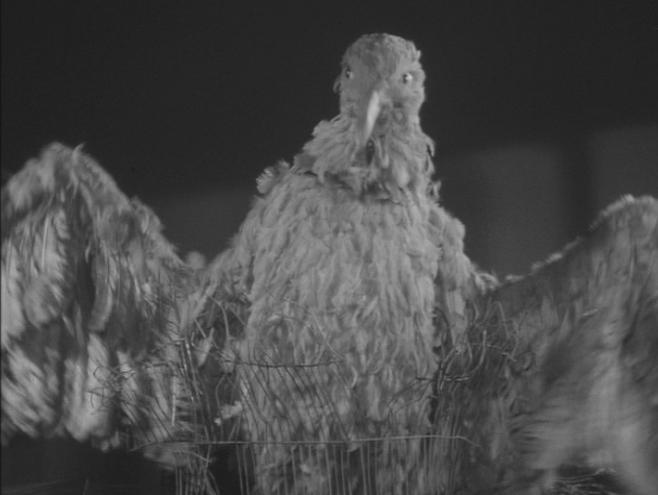
Larugeus is our second bird monster of the series and the more perplexing one of the two. While I find the prop used to portray the creature (a modification of the Rodan prop from Ghidorah again here) is a much more drab design compared to Litra and normally this would be a bit of a problem…but then we get to the episode itself.
Larugeus’ debut episode I Saw A Bird rarely shows the monster itself in its true form, waiting to unleash it during the episode’s climax. Rather, the monster’s attack on a zoo in the opening is shown from the perspective of the bird itself as well as what we, the audience see of the aftermath. Throughout the rest of the episode, Larugeus is portrayed by an actual bird (a java finch specifically) which adds to the tension as well as the general question of just what the hell is this thing? And whatever it is, how can it change size on a whim?
There’s also the creature’s origin itself: A prehistoric bird that somehow is found on an ancient sailing vessel. What seems like a run of the mill giant bird is a creature that is just downright strange, a perfect example of the dream logic that many Ultra Q stories run off of.
GARAMON
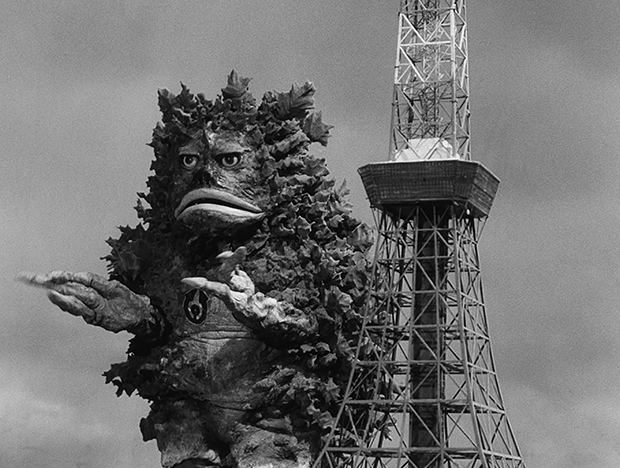
Well, here it is, what might possibly be one of the most iconic Ultra Q monsters, if not of the series in general. The monster is easily one of Tohl Narita’s strongest creature concepts and it’s easy to see why the monster has become an icon in it’s own right.
While Garamon may not appear to be one, it’s actually the franchise’s first ever robot monster, complete with cute little clanking sounds when it stomps around. A strange fact considering how Garamon looks organic makes me wonder why the creators of the robot (whom we’ll get to in just a bit) came to this decision. It’s not like they had a good reason to disguise Garamon as a living being for their invasion of Earth, so I assume this was just mainly for aesthetic purposes by the alien invaders. Another unique aspect regarding the machine is that it draws its energy from the metallic meteorite, essentially using it as an electronic brain. Should the meteorite be cut off from Garamon, the robot will cease function.
Garamon’s design is another really unique one, even amongst Ultra Q monsters. It’s once again reflective of the same philosophy Peguila and M1 have: Garamon is a Garamon and nothing else. The only animal I can really be reminded of are various fish like the lion fish or rock fish. I really like how it combines a lot of s features like the craggy, coral-like texture on the body, the pot belly, the weird, mammalian face and skeletal arms and legs to make Garamon feel like some weird alien creature and easily stick out of the crowd of Q kaiju. His frowning mug is one of my favorite things from the whole franchise. Garamon is a monster that embodies Ultra Q.
Garamon’s inception and journey to the screen is incredibly fascinating. The creature started life in a script entitled “Goro vs. The Space Monster” which would’ve featured Goro battling the titular creature. Eventually, Goro was removed from the story and it began to take shape closer to how we know the episode now. However, the version of the character in this second story was a bonafide creature over a robot whereupon in it, when the meteorite landed, the monster inside absorbed all the local wildlife in the area to construct it’s body. The skeletal limbs are actually leftovers from that iteration of the story.
Garamon would prove popular enough to appear in a followup episode where Earth is threatened by two Garamons at once. And while the monster has never returned proper, the creature has made plenty of cameos through the series. Most importantly however, is the fact that the suit would be reused in the following show for the monster Pigmon, a character who we’ll soon get to. The creature itself would also go onto inspire Garagon of Ultra Q: Dark Fantasy and Gamoran from Ultraman Cosmos. While Garamon has never had another starring role since the 60’s, it’s undeniable just how iconic and really cool the monster is. As I’ve said earlier, this might be the one Ultra Monster to truly embody them as an ideal.
 Easter's Kaiju Kompendium